Artificial Intelligence Verse Human creativity
AI: The Writer’s Enemy… or a Powerful Tool?
Every generation of writers has faced the same fear: Will this new technology replace us?
Today that question is being asked about Artificial Intelligence.
But if we step back and look at the history of storytelling, a pattern appears. Every major technological shift in writing has been met with skepticism, concern, and sometimes outright panic. Yet each innovation eventually became something writers used to strengthen their craft rather than replace it.
A Short Timeline of Writing Tools
Storytelling began long before technology existed.
Prehistoric storytelling started with spoken stories and cave paintings. Humans used images and oral tradition to pass knowledge and culture from one generation to the next.
Ancient civilizations then developed writing systems and tools such as clay tablets, papyrus, ink, and quills. These allowed stories, records, and ideas to be preserved.
The printing press (1440) revolutionized communication. Suddenly books could be produced at scale, spreading stories and knowledge to far more people than ever before.
Typewriters (late 1800s) made writing faster and more efficient, allowing authors to produce cleaner manuscripts.
Word processors and personal computers (1980s–1990s) transformed writing again. Editing, deleting, and reorganising text became easier, dramatically improving the writing process.
Spell-check and grammar software (1990s–2000s) began assisting writers by identifying errors and improving clarity.
Digital design tools like Photoshop and Canva (2000s–2010s) helped writers and publishers create professional book covers, graphics, and promotional materials.
And now we arrive at the newest tool in the long chain:
Artificial Intelligence.
AI as a Writing Assistant
AI can help writers in many practical ways.
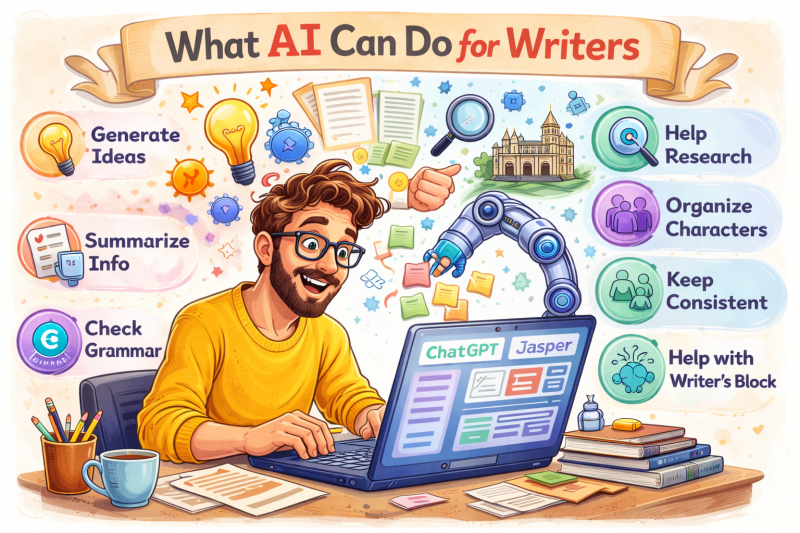
It can help organise ideas, summarise information, check grammar, brainstorm plot possibilities, research historical details, or remind a writer of character notes and previous chapters. For many authors, it acts almost like a research assistant or a second set of eyes.
Used correctly, AI can support the writing process without replacing the writer.
What AI Cannot Replace
Despite its impressive capabilities, AI lacks something fundamental.
It cannot feel. It is not human, and this is where writing comes alive.
Human storytelling comes from lived experience — joy, grief, fear, love, humour, loss, hope. Much of the emotional power of a story lives between the lines, not just in the words themselves.
A machine can analyse patterns of language, but it cannot truly understand the emotions that shape a human life.
And it is those emotions that make stories resonate. Writers are imperfectly perfect humans and no software can emulate that.
The Real Role of AI
The most useful way to view AI is not as a competitor, but as a tool.
Just like spell-check, word processors, or the printing press, it can make certain parts of the writing process faster and easier. It can support organisation, editing, and idea development.
But the heart of storytelling still belongs to the writer.
Technology can assist the craft, but the soul of a story — the imperfect, emotional, human layer — can only come from the person telling it.
The Takeaway
AI is not the enemy of writers.
It is simply the newest tool in a very long history of storytelling tools.
When used wisely, it can help writers protect what matters most: the authenticity of their voice and the truth of the story they want to tell.
Because in the end, the stories that stay with us are not the ones generated by machines.
"They are the ones that come from the human heart."
The image above highlights a key issue with AI. It will always produce an answer, but if the writer does not bring their own direction, creativity, and judgement to the process, the result is often something technically correct yet creatively wrong.
AI may be one of the most powerful tools writers have ever had access to.
But like every tool before it, its value depends on the person using it.
The creativity, vision, and voice still belong to the writer.